
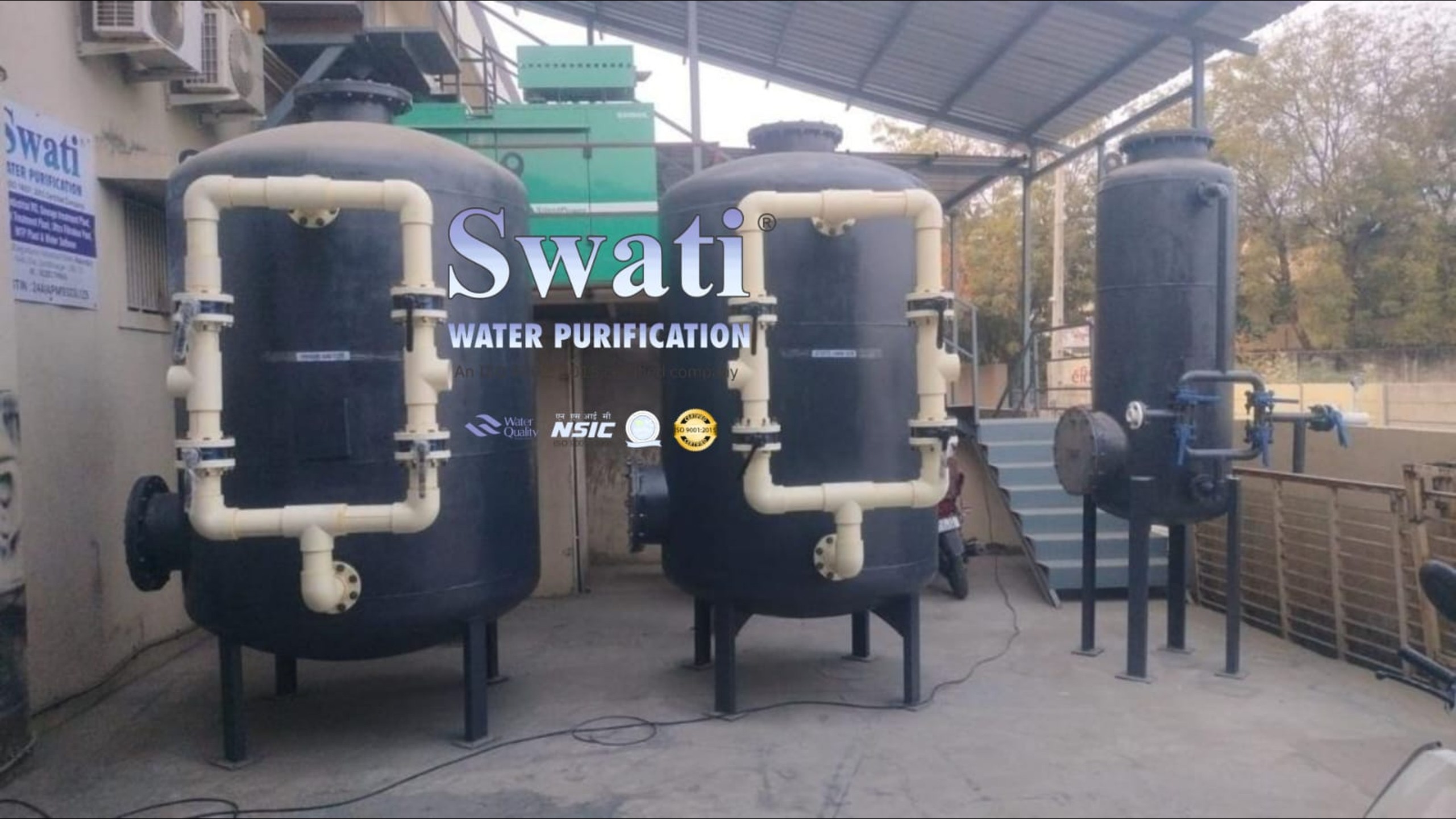
Leading Pressure Sand Filters Manufacturer In Gujarat: The Definitive Industrial Guide by Swati Water Purification
Water treatment begins with effective solid-liquid separation. Raw groundwater, river water, and industrial process fluids carry high loads of suspended solids, silt, clay particles, turbidity, and organic debris. When unmanaged, these suspended particles clog downstream Reverse Osmosis (RO) membranes, foul ion-exchange resins, damage high-pressure pumps, and ruin commercial output.
As a premier Pressure Sand Filters Manufacturer In Gujarat, Swati Water Purification engineers, fabricates, and installs heavy-duty Pressure Sand Filters (PSF) and multi-grade media filtration systems engineered for high flow rates, structural durability, and optimal turbidity reduction.
What is a Pressure Sand Filter (PSF)?
A Pressure Sand Filter (commonly known as a Dual-Media or Multi-Grade Sand Filter) is a closed pressure vessel designed to remove suspended solids, fine silt, dirt, and turbidity from water using graded layers of silica sand, quartz gravel, and pebbles.
Unlike open rapid sand filters that rely strictly on gravity, a Pressure Sand Filter operates under hydraulic pressure (2.0 to } 6.0 kg/cm2). Water is driven downwards through calibrated filter media beds, trapping particulates as small as 20 to 50 microns.
Operating Phases of a Pressure Sand Filter
1. Service Phase (Filtration Cycle)
Raw water enters through the top inlet distributor and flows downward through the media layers:
Top Layer (Fine Silica Sand): Strains fine suspended silt and organic particles.
Middle Layer (Coarse Quartz Sand): Traps medium-sized particles and stabilizes flow velocity.
Bottom Underbed (Pebbles & Gravel): Supports the upper sand layers, prevents media migration, and ensures uniform water distribution across bottom strainer nozzles.
As water passes through the bed, particulates adhere to the sand grains through mechanical straining, interception, and adsorption, delivering clean effluent with turbidity levels below 2 to 5 NTU.
2. Backwash Phase (Cleaning Cycle)
Over time, trapped dirt accumulates within the sand bed voids, increasing the pressure differential across the vessel
To clean the filter:
Valve orientation is reversed to send clean water upward from the bottom strainers at high velocity.
The upward flow fluidizes and expands the sand bed by 30% to 50%
Sand grains rub together, releasing trapped dirt, which is flushed out through the drain line.
Air scouring (optional) is activated to loosen stubborn sticky sludge before hydraulic backwashing.
3. Rinse Phase (Settling Cycle)
Following backwash, water flows downward through the bed for 3 to } 5 minutes to resettle the sand media and flush out any lingering particulates before re-entering the main process line.
Specialized RO Plant & Water Treatment Services Across Major Metropolitan Areas
In addition to pressure sand filters, Swati Water Purification specializes in supplying, installing, and commissioning Reverse Osmosis (RO) Plants and comprehensive filtration suites for commercial and industrial clients across key industrial regions:
Coverage Area & Primary Application Breakdown
Ahmedabad & Gandhinagar: Supplying GIDC estates like Naroda, Odhav, Vatva, Changodar, Sanand, and Kalol for pharmaceutical pretreatment, textile dyeing, and automotive component washing.
Surat & Vadodara: Serving Hazira, Sachin, Pandesara, Makarpura, Nandesari, and Ankleshwar for petrochemical cooling towers, chemical processing, and synthetic textiles.
Mumbai, Pune & Nashik: Providing systems to Taloja, TTC Belapur, Bhosari, Chakan, Ambad, and Satpur for precision metallurgy, biotech, auto assembly, and commercial real estate.
Bhopal & Indore: Installations across Mandideep, Govindpura, Pithampur, and Sanwer Road for heavy machinery, food processing, and beverage production.
Jaipur & Kanpur: Catering to Sitapura, Vishwakarma (VKI), Panki, and Jajmau for leather tanneries, textile printing, thermal power plants, and chemical synthesis.
Primary Applications of Pressure Sand Filters
Pressure Sand Filters act as essential primary treatment units across diverse industrial and commercial sectors:
1. Pre-Treatment for Reverse Osmosis (RO) Plants
RO membranes feature microscopic pore sizes susceptible to fouling by suspended solids and colloidal silt. Placing a Pressure Sand Filter upstream protects RO membranes from physical fouling, extending membrane lifespan and lowering cartridge replacement costs.
2. Cooling Tower Side-Stream Filtration
Open-loop cooling towers absorb airborne dust, organic debris, and rust particles. Side-stream filtration using a Pressure Sand Filter continuously cleans 5% to 10% of circulating water, preventing basin sludge accumulation and heat exchanger fouling.
3. Industrial Process Water Clarification
Textile dyeing units, paper mills, leather tanneries, and food processing plants use sand filters to clarify raw surface water (from rivers, canals, or borewells) for process utility lines.
Key Benefits of Installing Swati Pressure Sand Filters
Investing in a pressure sand filter from Swati Water Purification offers operational and economic advantages:
High Solids Removal Efficiency: Effectively removes turbidity, suspended silt, algae, and organic particles down to 20 microns.
Protects Downstream Equipment: Prevents premature fouling of RO membranes, softener resin beds, UV disinfectants, and precision control valves.
Low Operational & Maintenance Costs: Requires no continuous chemical dosing for basic filtration; periodic backwashing with raw or filtered water cleans the media bed.
Durable Construction: Built using high-grade FRP or MSRL vessels resistant to chemical corrosion, pressure surges, and environmental weathering.
Ease of Operation: Available with multi-port valves or automated PLC-driven valve manifolds for hassle-free backwashing cycles.
Frequently Asked Questions (FAQs)
Q1. How often should a Pressure Sand Filter be backwashed?
Backwashing frequency depends on raw water turbidity and operating hours. Typically, filters are backwashed once every 8 to 24 hours, or whenever the pressure differential (Delta P) across the vessel exceeds 0.8 kg/cm2.
Q2. What is the average lifespan of filter sand media?
With regular backwashing and proper pre-treatment, silica sand media lasts between 3 to years. Media should be topped up or replaced if sand grains become smooth, rounded, or contaminated with oil/grease.
Q3. Can a Pressure Sand Filter remove dissolved salts (TDS) or hardness?
No. Pressure Sand Filters only remove physical suspended solids and turbidity. To remove dissolved salts (TDS), you need a Reverse Osmosis (RO) Plant; to remove hardness (calcium/magnesium), you need a Water Softener.
Q4. What vessel materials are best for Pressure Sand Filters?
FRP Vessels: Ideal for small to medium flow rates (1 to 30M3/Hr), lightweight, and 100% corrosion-proof.
MSRL / MSEC Vessels: Best for high flow rates (>30 M3/Hr) and high pressure applications due to structural strength.
Q5. Does Swati Water Purification provide multi-city supply and installation support?
Yes. We manufacture, supply and install across major metropolitan areas including Ahmedabad, Gandhinagar, Surat, Vadodara, Mumbai, Pune, Nashik, Bhopal, Indore, Jaipur, Kanpur, and surrounding industrial estates.
Protect your downstream equipment, optimize process water clarity, and secure reliable filtration performance. Contact our engineering team today for custom vessel sizing, media selection, and technical quotes.
Contact Us: +91 98251 83643 | +91 70439 99563
E-Mail : info@swatiwater.com | sales@swatiwater.com