
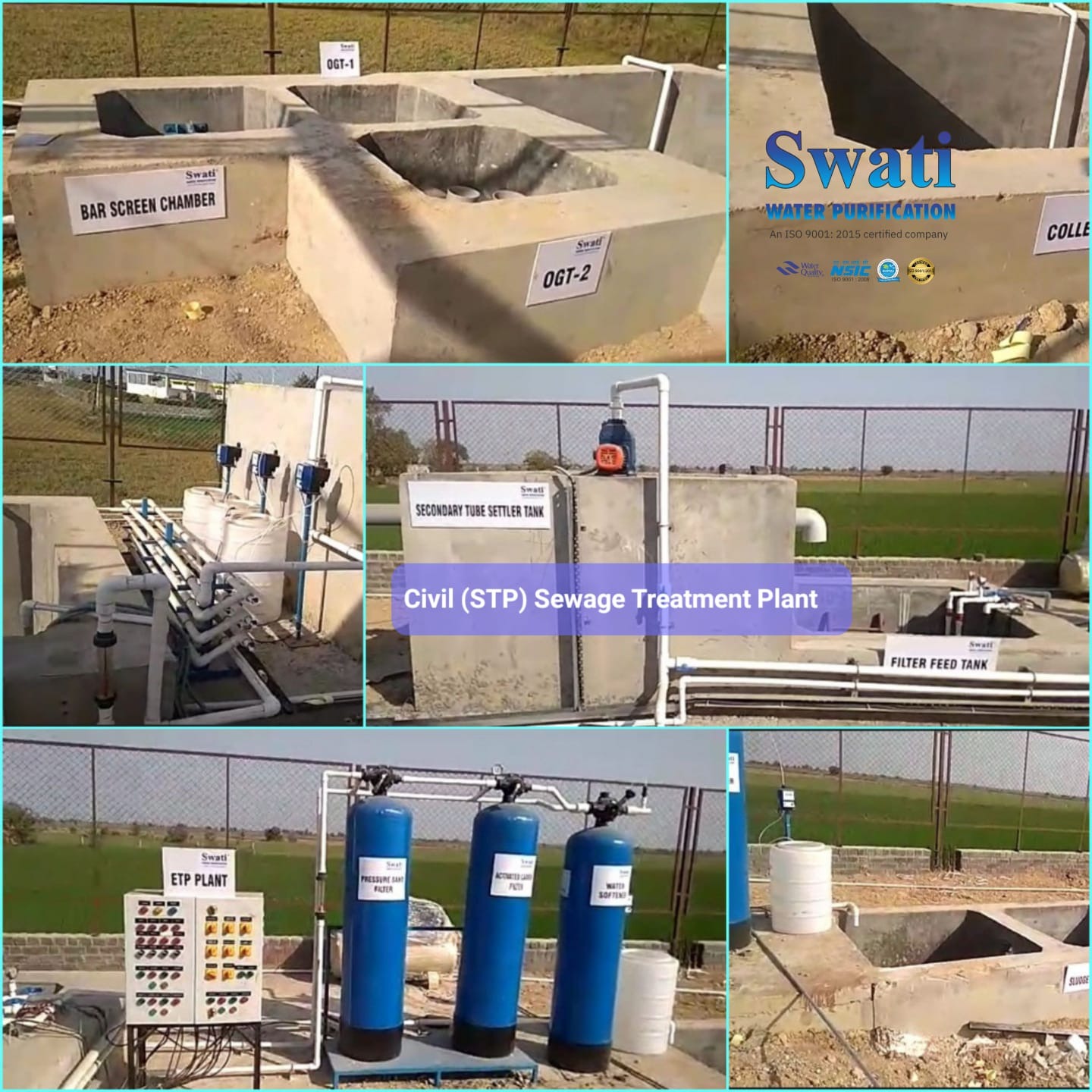
Underground Sewage Treatment Plant Manufacturer in Gujarat | Swati Water Purification
Rapid urban growth and industrial expansion across Gujarat have made space optimization and sustainable water management top priorities. Commercial hubs, residential townships, and industrial facilities often face a common challenge: managing domestic and industrial wastewater effectively without losing valuable ground surface area.
Swati Water Purification provides specialized Underground Sewage Treatment Plants (STP) engineered specifically to solve this challenge. As a premier Underground Sewage Treatment Plant Manufacturer in Gujarat, we design, manufacture, and install compact, subsurface wastewater treatment systems that deliver high efficiency, regulatory compliance, and eco-friendly water recycling.
Why Choose an Underground Sewage Treatment Plant (USTP)?
Traditional above-ground sewage treatment facilities require substantial real estate, generate visual clutter, and can cause odor complaints if not managed properly. An Underground Sewage Treatment Plant (USTP) is built below ground level—utilizing reinforced concrete (RCC), fiber-reinforced plastic (FRP), or coated mild steel (MS) tanks.
Key Features of Modern Underground STPs
Space Preservation: The entire biological treatment setup is subterranean. Surface ground space remains 100% usable for parking lots, gardens, driveways, or recreational spaces.
Odor-Free & Quiet: Equipped with enclosed, heavy-duty sealed covers and specialized forced ventilation systems. Fine-bubble aeration keeps the process aerobic, preventing foul odors and minimizing operational noise.
Aesthetic Integration: Subsurface designs eliminate unsightly open tanks, keeping properties neat and modern.
Weather-Proof Operation: Below-ground placement shields system tanks and biological reactors from ambient temperature spikes, UV degradation, and extreme weather.
Automated Functionality: Systems can be integrated with semi-automatic or fully automated Programmable Logic Controller (PLC) panels for low-touch operation.
Swati Water Purification: Advanced Technology & Engineering
At Swati Water Purification, every underground sewage treatment system is built to meet strict environmental guidelines set by the Gujarat Pollution Control Board (GPCB) and Central Pollution Control Board (CPCB). We integrate high-efficiency, multi-stage biological technologies tailored to your facility's volume and footprint requirements.
Core Technologies Integrated
MBBR (Moving Bed Biofilm Reactor): High-density bio-media provide a massive surface area for microorganism growth, making MBBR underground STPs highly compact and stable during load surges.
SBR (Sequencing Batch Reactor): A batch-based process that combines equalisation, biological reaction, and secondary clarification inside a single tank, reducing installation footprint.
MBR (Membrane Bioreactor): Combines biological treatment with ultrafiltration membranes to produce exceptionally clear water suitable for advanced non-potable reuse.
Nationwide Supply Capabilities: Commercial Reverse Osmosis (RO) Plants
In addition to wastewater and sewage management, Swati Water Purification specializes in designing, supplying, and installing high-capacity Commercial & Industrial Reverse Osmosis (RO) Plants across major industrial hubs and metropolitan cities throughout India.
Whether your operations need high-purity water for boiler feed, food processing, pharmaceuticals, or industrial manufacturing, we deliver customized RO systems directly to your site.
Primary Regions Served
Gujarat: Ahmedabad, Gandhinagar, Surat, Vadodara, Rajkot, Bhavnagar, Jamnagar, Vapi.
Maharashtra: Mumbai, Pune, Nashik, Nagpur, Aurangabad, Thane.
Madhya Pradesh: Bhopal, Indore, Gwalior, Jabalpur.
Rajasthan: Jaipur, Udaipur, Jodhpur, Kota.
Uttar Pradesh: Kanpur, Lucknow, Noida, Agra, Varanasi.
Our commercial RO plants range from 150 LPH up to 50,000+ LPH, featuring Thin-Film Composite (TFC) membranes, high-pressure pumps, multi-stage pre-filtration, and automatic flush cycles to lower operational costs.
Key Applications of Underground STPs
Subsurface sewage treatment plants serve diverse sectors where surface land carries high commercial value or strict aesthetic and environmental standards apply:
Residential Townships & High-Rise Apartments: Modern housing developments require clean wastewater management systems that do not occupy parking spots or open gardens. Underground STPs treat daily domestic wastewater quietly and supply treated water back into dual-plumbing networks for toilet flushing and landscape irrigation.
Commercial Centers, Malls & Corporate Parks: High-density commercial buildings generate significant sewage daily. Underground systems process high peak inflows efficiently without disrupting visitor traffic or creating unappealing site conditions.
Hotels, Resorts & Hospitality Venues: In luxury hospitality, guest comfort and ambiance are paramount. An underground STP operates out of sight and scent, ensuring smooth environmental compliance while supplying treated water to maintain hotel lawns and gardens.
Healthcare Facilities & Hospitals: Hospitals generate significant liquid waste that requires reliable biological treatment prior to release. Underground installations offer safe containment and steady operation on tight hospital grounds.
Educational Campuses & Universities: Large university and institutional grounds require decentralized sewage treatment spread across housing units and administrative blocks. Below-ground STPs keep grounds safe, clean, and open for academic and athletic use.
How an Underground Sewage Treatment System Works
Understanding the step-by-step treatment process helps plant managers plan installation and ongoing oversight:
Preliminary Treatment (Screening & Grit Removal): Sewage passes through coarse and fine mechanical bar screens that capture large solids, debris, plastics, and floating material.
Primary Equalization: Wastewater collects in a subterranean equalization tank equipped with mixing diffusers. This homogenizes flow rates and organic concentrations before biological processing.
Biological Aeration: Air blowers force oxygen into fine-bubble diffusers inside the bio-reactor. Aerobic bacteria break down organic pollutants (measured as BOD and COD) into carbon dioxide and water.
Secondary Clarification & Settling: Biological solids form sludge and settle at the tank bottom, leaving clear water on top. Settled sludge is either recycled back into the reactor or pumped to a sludge holding tank.
Tertiary Treatment & Disinfection: The clear water passes through pressure sand filters and activated carbon filters, followed by chlorination or UV disinfection to destroy bacteria and pathogens.
Storage & Reuse: The final purified water is pumped to elevated or underground storage tanks for flushing, gardening, or industrial processes.
Frequently Asked Questions (FAQs)
Q1: Do underground sewage treatment plants emit bad smells?
No. Modern underground STPs engineered by Swati Water Purification feature sealed tank lids, forced air ventilation stacks, and continuous aerobic fine-bubble aeration. By keeping the biological process aerobic, anaerobic decomposition is prevented, eliminating foul odors.
Q2: How much ground space can be saved by installing an STP underground?
An underground STP saves up to 100% of surface footprint. Because all major tanks are located underground, the surface area above can be paved over for parking, landscaped into gardens, or used for open paved areas.
Q3: What quality standards must the treated output water meet in Gujarat?
Treated sewage must comply with the environmental discharge norms established by the GPCB and CPCB. Parameters typically require:
pH: 6.5 – 8.5
BOD (Biochemical Oxygen Demand): < 10 mg/L (for urban reuse)
COD (Chemical Oxygen Demand): < 50 mg/L
TSS (Total Suspended Solids): < 10 mg/L
Q4: Can the treated water from an underground STP be used for drinking?
No. Output water from an STP is intended for non-potable applications such as toilet flushing, garden irrigation, cooling tower makeup, construction activities, and floor washing.
Q5: What capacity STP is required for a residential apartment complex?
Capacity depends on total occupancy. Assuming an average water consumption of 135 Liters Per Capita per Day (LPCD) with approximately 80% converted to sewage, a residential complex housing 500 residents typically requires a 50 KLD to 60 KLD underground STP.
Q6: How often does an underground STP require sludge removal and servicing?
Depending on system load and technological design (MBBR), excess digested sludge is usually removed once every 3 to 6 months. Regular quarterly maintenance checks cover air blower lubrication, pump seal inspections, filter backwashing, and panel testing.
Q7: Does Swati Water Purification provide installation and maintenance support outside Gujarat?
Yes. We provide complete turnkey supply, installation and commissioning across major cities in India, including Mumbai, Pune, Nashik, Bhopal, Indore, Jaipur, and Kanpur.
Partner with Swati Water Purification
Avoid regulatory fines, eliminate space constraints, and lower overall water expenses with a custom-engineered underground sewage treatment plant.
Contact Us: +91 98251 83643 | +91 70439 99563
E-Mail : info@swatiwater.com | sales@swatiwater.com