
Comprehensive Guide: Choosing a 2500 LPH Industrial RO Plant Manufacturer in Gujarat
Water is the lifeblood of high-capacity industrial, commercial, and municipal operations. As major industrial clusters rapidly expand across Gujarat and India’s primary manufacturing corridors, securing a continuous supply of treated, high-purity process water has become essential for maintaining operational continuity, product standards, and environmental compliance.
Raw water sourced from deep borewells, surface bodies, GIDC industrial estates, and municipal pipelines often contains elevated levels of Total Dissolved Solids (TDS), silica, heavy metals, chlorides, and mineral hardness. When fed directly into industrial boilers, cooling towers, heat exchangers, or delicate production lines, these impurities cause severe scale encrustation, pipe clogging, chemical degradation, and expensive operational downtime.
This comprehensive guide details the technical architecture, operational benefits, application domains, and key purchasing criteria for a 2500 LPH Industrial Reverse Osmosis (RO) Plant, highlighting why Swati Water Purification stands out as a leading manufacturer in Gujarat and across India.
What is a 2500 LPH Industrial RO Plant?
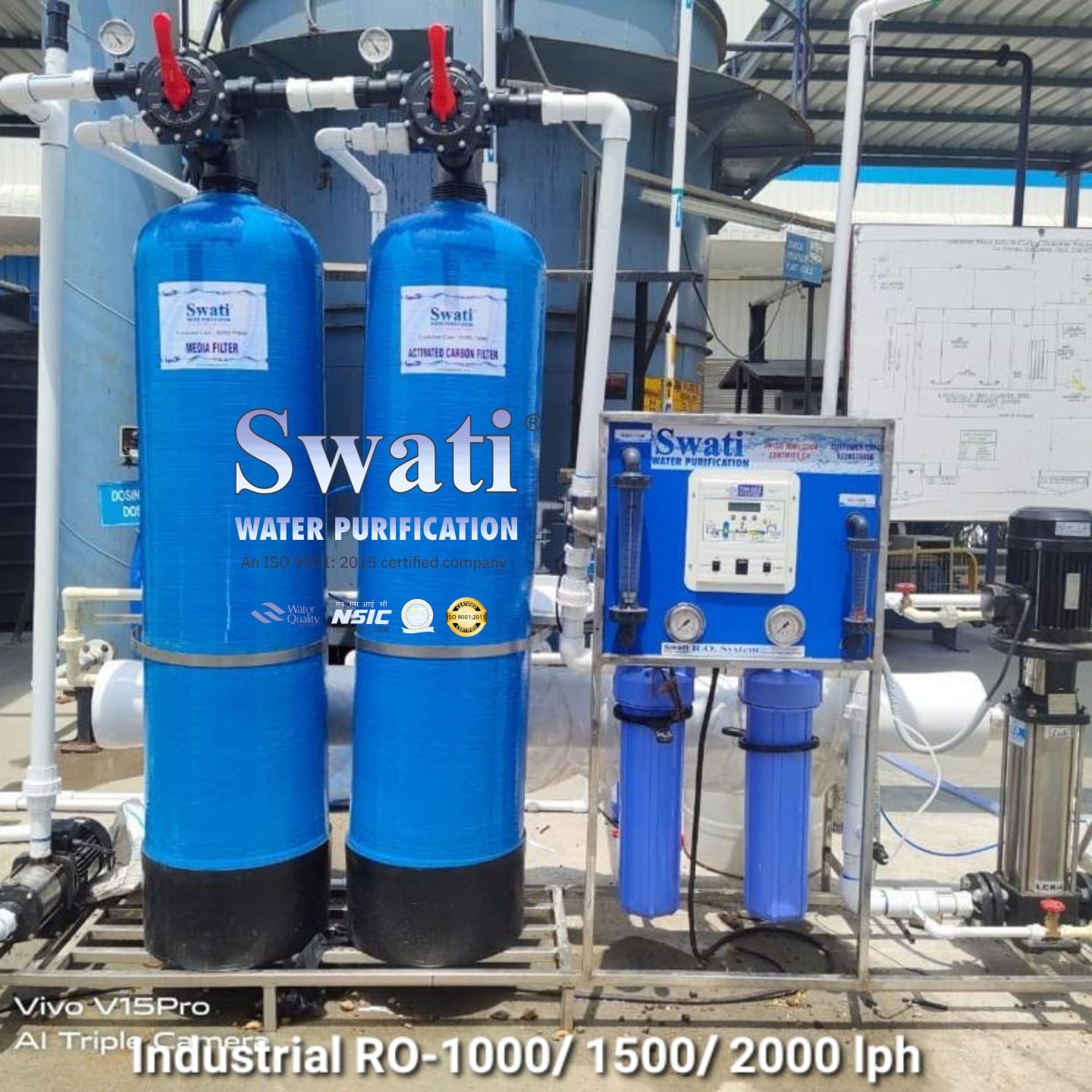
A 2500 LPH (Liters Per Hour) Industrial RO Plant—also classified as a 2.5 KLPH or 2.5 $m^3/hr$ system—is a heavy-duty, high-capacity water purification plant engineered to generate 2,500 liters of purified water every hour. When operated continuously across standard multi-shift industrial cycles, it yields 20,000 to 50,000+ liters of high-purity water daily.Using advanced Reverse Osmosis (RO) membrane separation, the system uses high-pressure multistage pumps to push pressurized raw water through semi-permeable Thin-Film Composite (TFC) membranes. This process strips away up to 95%–98% of dissolved inorganic minerals, heavy metals, silica, microorganisms, and inorganic salts, producing clean, low-TDS water ready for demanding technical and drinking applications.
Industrial & Commercial Applications
A 2500 LPH capacity provides the substantial volume required by large industrial setups, real estate projects, commercial infrastructure, and institutional sites.
1. Large Real Estate, Housing Societies & Builder Townships
Commercial builders, residential high-rises, and township developments install 2500 LPH RO systems to supply safe, low-TDS drinking water to thousands of residents while preventing limescale damage to central plumbing, solar water heaters, and sanitary fixtures.
2. Textile Mills, Fabric Processing & Dyeing Units
Textile processing and fabric dyeing require soft, low-TDS water free from iron and hardness salts. This prevents fabric discoloration, ensures uniform dye uptake, and protects expensive processing boilers from scaling.
3. Pharmaceuticals, Biotechnology & Medical Complexes
Pharmaceutical formulation plants, diagnostic laboratories, large hospitals, and hemodialysis units depend on high-purity water free of pyrogens, endotoxins, and minerals for wash cycles, chemical formulation, and laboratory work.
4. Food, Beverage & Bottling Plants
Food processing units, commercial dairies, fruit juice packaging lines, and mineral water bottling facilities use 2500 LPH RO plants as an ingredient water source, ensuring hygiene, consistent taste, and compliance with food safety regulations.
5. Chemical Plants, Electroplating & Automotive Manufacturing
Chemical synthesis facilities, metal finishing units, electroplating plants, and automotive manufacturing shops use 2500 LPH RO systems for rinsing parts, mixing plating baths, and avoiding surface spots during coating procedures.
Pan-India Reach: Serving Gujarat & Major Metropolitan Cities
Swati Water Purification manufactures, installs, and services water treatment systems across industrial corridors in Gujarat and major urban centers across India:
[ SWATI WATER PURIFICATION NETWORK ]
|
+---------------------------+------------------------------------------------------+
| |
[ GUJARAT INDUSTRIAL HUBS ] [ MAJOR METROPOLITAN CENTERS ]
- Ahmedabad (Rakanpur/Santej/Odhav) - Mumbai & Pune (Maharashtra)
- Gandhinagar (Kalol GIDC) - Nashik & Nagpur (Maharashtra)
- Surat (Hazira/Palsana/Sachin GIDC) - Bhopal & Indore (Madhya Pradesh)
- Vadodara (Makarpura/Nandesari) - Jaipur & Udaipur (Rajasthan)
- Rajkot, Ankleshwar, Vapi, Jamnagar - Kanpur & Lucknow (Uttar Pradesh)
Our installation, commissioning, and technical support services cover:
Gujarat Hubs: Ahmedabad, Gandhinagar, Surat, Vadodara, Rajkot, Ankleshwar, Vapi, Jamnagar, Bhavnagar, and Kalol.
Maharashtra Hubs: Mumbai, Pune, Nashik, Thane, Navi Mumbai, Nagpur, and Chhatrapati Sambhajinagar.
Central & Western India: Bhopal, Indore, Jaipur, Udaipur, and Jodhpur.
Northern Industrial Belts: Kanpur, Lucknow, Noida, Gurugram, and Ghaziabad.
Our technical team manages everything from initial water quality testing and custom skid design to on-site assembly, commissioning, operator training, and post-installation service.
Frequently Asked Questions (FAQs)
Q1. What is the price of a 2500 LPH Industrial RO Plant in Gujarat?
Prices generally range depending on component configuration (e.g., SS-304 vs. MS skid frames, FRP vs. SS pressure vessels, PLC vs. semi-automatic panels, and pump brand choices).
Q2. How much power does a 2500 LPH RO plant consume?
A standard 2500 LPH industrial RO system consumes approximately 7.5 kW to 11 kW per hour of electricity (operating on 3-phase 415V power), driven mainly by the high-pressure vertical multistage pump and raw water feed pump.
Q3. How long do 8040 RO membranes last in a 2500 LPH plant?
With proper pre-treatment backwashing, regular cartridge replacements, and correct antiscalant dosing, high-quality industrial 8040 RO membranes typically last 2 to 3 years.
Q4. Can a 2500 LPH RO plant reduce water TDS from 4,500 PPM to safe levels?
Yes. High-rejection TFC membranes achieve 95% to 98% salt rejection, lowering a 4,500 PPM raw water feed down to 90–180 PPM, making it ideal for process lines, boilers, and safe drinking.
Q5. What is the recovery rate, and can reject water be reused?
Standard 2500 LPH RO plants maintain a 50% to 60% recovery rate, producing 2,500 LPH of pure water and roughly 1,600–2,500 LPH of concentrated reject brine. This reject water can be repurposed for floor washing, flushing toilets, landscaping, or cooling tower make-up feed.
Contact Us: +91 98251 83643 | +91 70439 99563
E-Mail : info@swatiwater.com | sales@swatiwater.com