
Comprehensive Guide: Choosing a 6000 LPH Industrial RO Plant Manufacturer in Gujarat
Water is a primary operational utility across high-capacity industrial manufacturing, chemical processing, pharmaceutical synthesis, commercial real estate, and municipal infrastructure. Across Gujarat’s industrial belts and India’s primary manufacturing corridors, securing a continuous, high-volume supply of purified process water is critical for maintaining operational uptime, protecting capital equipment, and ensuring strict product compliance.
Raw water extracted from deep borewells, surface bodies, GIDC industrial supply lines, and municipal mains routinely contains elevated levels of Total Dissolved Solids (TDS), silica, heavy metals, chlorides, and mineral hardness. When introduced into high-pressure boilers, cooling towers, heat exchangers, or precision chemical processes without proper conditioning, these impurities cause rapid mineral scaling, heat loss, pipe encrustation, and unexpected facility shutdowns.
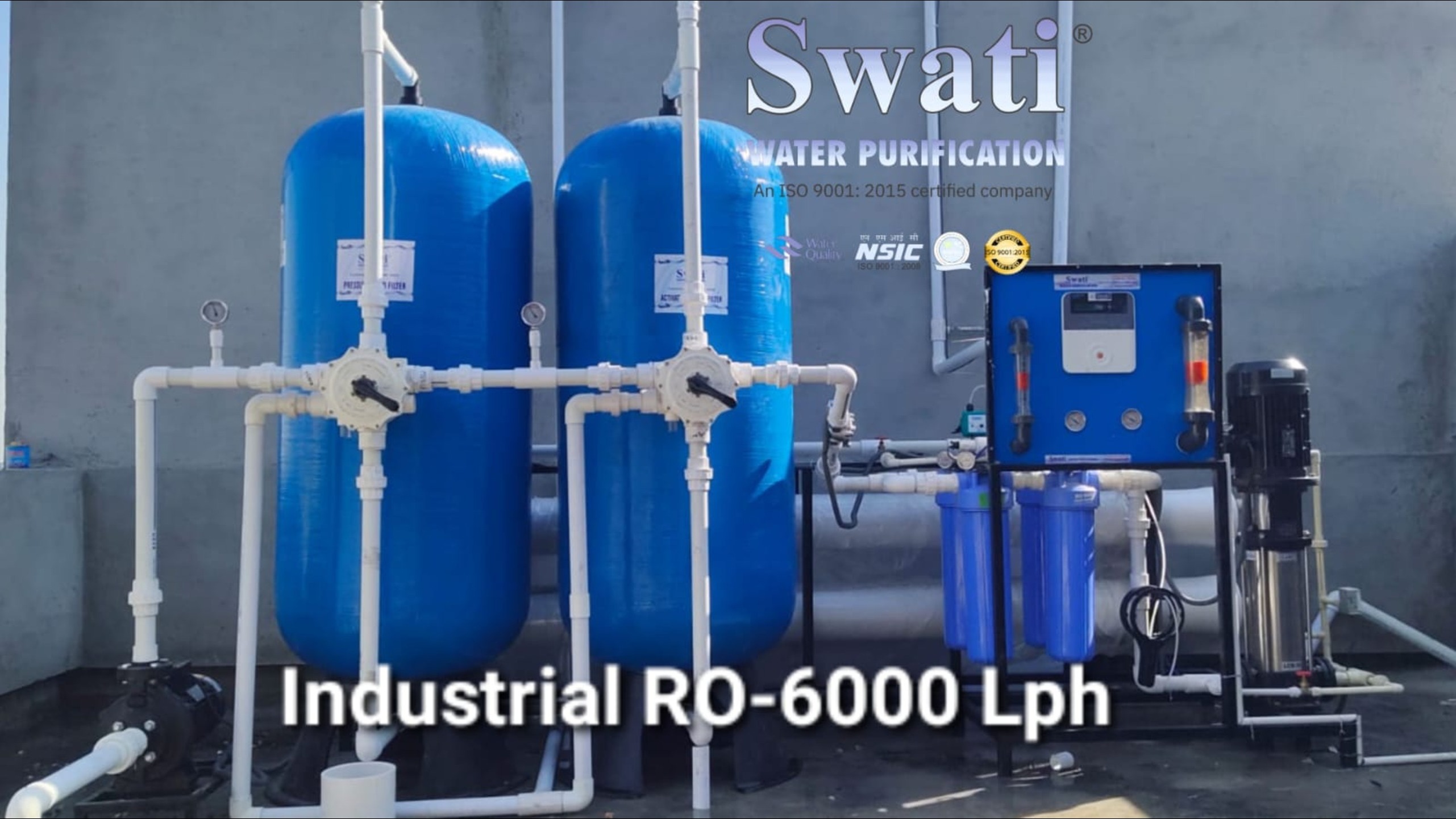
This detailed guide covers the technical architecture, operating principles, application domains, economic benefits, and purchasing criteria for a 6000 LPH Industrial Reverse Osmosis (RO) Plant, demonstrating why Swati Water Purification is a trusted engineering partner and equipment manufacturer in Gujarat.
Industrial & Commercial Applications
A 6000 LPH industrial RO plant delivers the high continuous volume required by large industrial setups, real estate projects, commercial infrastructure, and institutional sites.
1. Large Real Estate, Housing Societies & Builder Townships
Commercial builders, residential high-rises, IT parks, and township developments install 6000 LPH RO systems to supply safe, low-TDS drinking water to thousands of residents while preventing limescale damage to central plumbing, solar water heaters, and sanitary fixtures.
2. Textile Mills, Fabric Processing & Dyeing Units
Textile processing and fabric dyeing require soft, low-TDS water free from iron and hardness salts. This prevents fabric discoloration, ensures uniform dye uptake, and protects expensive processing boilers from scaling.
3. Pharmaceuticals, Biotechnology & Medical Complexes
Pharmaceutical formulation plants, diagnostic laboratories, large hospitals, and hemodialysis units depend on high-purity water free of pyrogens, endotoxins, and minerals for wash cycles, chemical formulation, and laboratory work.
4. Food, Beverage & Bottling Plants
Food processing units, commercial dairies, fruit juice packaging lines, and mineral water bottling facilities use 6000 LPH RO plants as an ingredient water source, ensuring hygiene, consistent taste, and compliance with food safety regulations.
5. Chemical Plants, Electroplating & Automotive Manufacturing
Chemical synthesis facilities, metal finishing units, electroplating plants, and automotive manufacturing shops use 6000 LPH RO systems for rinsing parts, mixing plating baths, and avoiding surface spots during coating procedures.
Pan-India Reach: Serving Gujarat & Major Metropolitan Cities
Swati Water Purification specializes in supplying and installing Reverse Osmosis plants for businesses located in major metropolitan areas and industrial hubs across Gujarat and India:
[ SWATI WATER PURIFICATION NETWORK ]
|
+--------------------------------------+----------------------------------------+
| |
( GUJARAT INDUSTRIAL HUBS ) ( MAJOR METROPOLITAN CENTERS )
- Ahmedabad (Rakanpur/Santej/Odhav) - Mumbai & Pune (Maharashtra)
- Gandhinagar (Kalol GIDC) - Nashik & Nagpur (Maharashtra)
- Surat (Hazira/Palsana/Sachin GIDC) - Bhopal & Indore (Madhya Pradesh)
- Vadodara (Makarpura/Nandesari) - Jaipur & Udaipur (Rajasthan)
- Rajkot, Ankleshwar, Vapi, Jamnagar - Kanpur & Lucknow (Uttar Pradesh)
Our installation, commissioning, and technical support services cover:
Gujarat Hubs: Ahmedabad, Gandhinagar, Surat, Vadodara, Rajkot, Ankleshwar, Vapi, Jamnagar, Bhavnagar, and Kalol.
Maharashtra Hubs: Mumbai, Pune, Nashik, Thane, Navi Mumbai, Nagpur, and Chhatrapati Sambhajinagar.
Central & Western India: Bhopal, Indore, Jaipur, Udaipur, and Jodhpur.
Northern Industrial Belts: Kanpur, Lucknow, Noida, Gurugram, and Ghaziabad.
Our technical team manages everything from initial water quality testing and custom skid design to on-site assembly, commissioning, operator training, and post-installation service.
Recommended Maintenance Schedule for 6000 LPH RO Plants
Routine preventive maintenance helps preserve permeate flow rates, prolongs membrane service life, and prevents unexpected downtime.
Why Choose Swati Water Purification?
Partnering with an experienced water treatment plant manufacturer gives you access to durable equipment, quick spare parts availability, and expert technical support. Swati Water Purification provides:
Decades of Engineering Experience: Manufacturing water treatment systems, including RO, Sewage Treatment Plants (STP), Demineralization (DM), and Ultrafiltration (UF) plants.
High-Grade Industrial Components: Utilizing food-grade FRP/SS vessels, rigid SS-304 skid frames, high-rejection 8040 membranes, and vertical multistage pumps.
Custom Engineering: Systems tailored to match your specific feed water TDS, space limits, and operational capacity requirements.
Frequently Asked Questions (FAQs)
Q1. What is the price of a 6000 LPH Industrial RO Plant in Gujarat?
Prices generally range depending on component configuration (e.g., SS-304 vs. MS skid frames, FRP vs. SS pressure vessels, PLC vs. semi-automatic panels, and pump brand choices).
Q2. How much power does a 6000 LPH RO plant consume?
A standard 6000 LPH industrial RO system consumes approximately 18.5 kW to 25 kW per hour of electricity (operating on 3-phase 415V power), driven mainly by the high-pressure vertical multistage pump and raw water feed pump.
Q3. How long do 8040 RO membranes last in a 6000 LPH plant?
With proper pre-treatment backwashing, regular cartridge replacements, and correct antiscalant dosing, high-quality industrial 8040 RO membranes typically last 2 to 3 years.
Q4. Can a 6000 LPH RO plant reduce water TDS from 5,000 PPM to safe levels?
Yes. High-rejection TFC membranes achieve 95% to 98% salt rejection, lowering a 5,000 PPM raw water feed down to 100–200 PPM, making it ideal for process lines, boilers, and safe drinking.
Q5. What is the recovery rate, and can reject water be reused?
Standard 6000 LPH RO plants maintain a 50% to 60% recovery rate, producing 6,000 LPH of pure water and roughly 4,000–6,000 LPH of concentrated reject brine. This reject water can be repurposed for floor washing, flushing toilets, landscaping, or cooling tower make-up feed.
Contact Us: +91 98251 83643 | +91 70439 99563
E-Mail : info@swatiwater.com | sales@swatiwater.com