
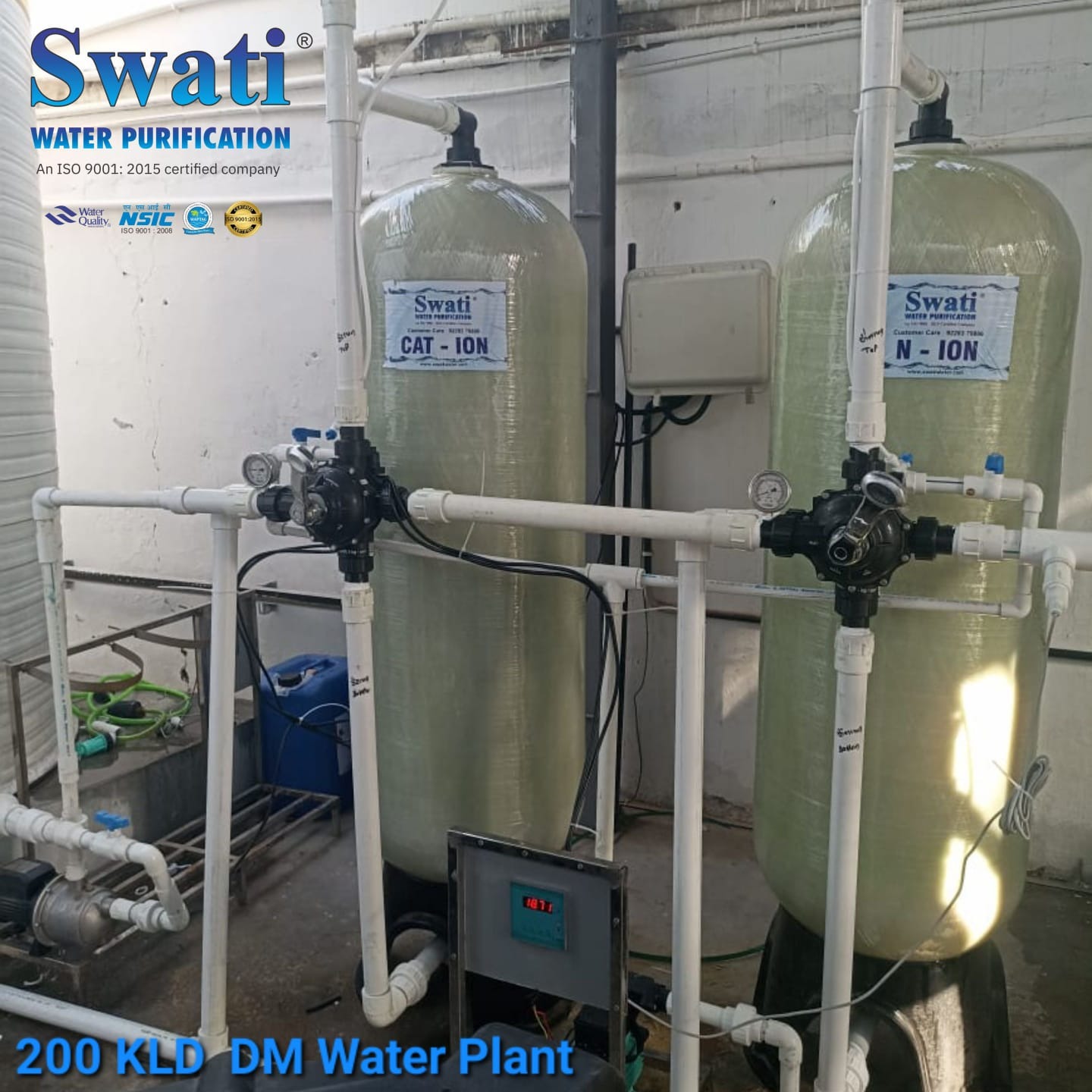
Engineering Absolute Purity: The Comprehensive Guide to DM Water Plants
In the domain of modern industrial manufacturing, high-pressure power generation, and precision chemical synthesis, standard municipal or borewell water is entirely inadequate. Containing a complex matrix of dissolved mineral salts, ionic contaminants, and trace silica, untreated water introduces catastrophic risks of scaling, corrosion, and product contamination when exposed to intense heat or reactive environments. To achieve near-zero conductivity and complete ionic elimination, heavy industries rely on specialized ion-exchange systems: the DM Water Plant.
At Swati Water Purification, we engineer, manufacture, supply, and install elite water and wastewater treatment infrastructure. Alongside our advanced Demineralization (DM) water systems, we specialize in supplying and installing custom commercial and industrial Reverse Osmosis (RO) plants for businesses located across major commercial corridors—including Ahmedabad, Gandhinagar, Gujarat, Surat, Vadodara, Mumbai, Pune, Nashik, Bhopal, Indore, Jaipur, Kanpur, and beyond.
Multi-Stage Purification Sequence:
Cation Exchange Bed: Raw feedwater passes through pressure vessels packed with acid-resistant synthetic resins charged with hydrogen (H+) ions. Mineral cations bind to the resin matrix, releasing hydrogen ions into the water.
Anion Exchange Bed: The decationized water then flows through an anion vessel laden with basic resins that trap negative ions and release hydroxyl (OH-) ions, which instantly bond with hydrogen to form pure water (H2O).
Mixed Bed Polishing Unit (Optional): For ultra-pure specifications, a mixed bed polisher combines both cation and anion resins in a single vessel to eliminate trace residual ions.
Automated Chemical Regeneration: Once resin beds reach chemical saturation, they undergo a systematic regeneration cycle using acid (for cation resins) and caustic soda (for anion resins) to restore full operational performance.
Holistic Water Engineering: Integrating RO and DM Systems
Effective industrial water management requires a synchronized pre-treatment and polishing approach. Feeding high-TDS (Total Dissolved Solids) raw water directly into a DM plant can exhaust ion-exchange resins prematurely, driving up chemical consumption and operating overheads.
To maximize system efficiency, Swati Water Purification designs and delivers fully integrated, turnkey water purification ecosystems. Our core technical portfolio features:
Industrial DM Water Plants: Custom-configured systems ranging from compact 500 LPH units to high-capacity industrial plants exceeding 100 m3/hr.
Commercial & Industrial RO Plants: High-recovery Reverse Osmosis desalination systems custom-engineered to lower incoming TDS levels prior to DM polishing or for direct industrial reuse.
Pre-Treatment Filtration Systems: Heavy-duty pressure sand filters, activated carbon filters, and multi-grade media designed to protect downstream equipment from suspended solids and organic fouling.
Our technical service network extends nationwide, providing localized consultations, precise mechanical installations, and responsive maintenance support to clients in Ahmedabad, Gandhinagar, Gujarat, Surat, Vadodara, Mumbai, Pune, Nashik, Bhopal, Indore, Jaipur, Kanpur, and surrounding regional hubs.
Diverse Industrial Applications
Demineralization plants are indispensable across various sectors where mineral-free water is a mandatory operational requirement:
1. High-Pressure Boilers and Thermal Power Stations
Boilers operating under immense thermal and barometric pressure require ultra-pure feedwater. Mineral impurities cause severe scale deposition, tube overheating, and catastrophic pressure ruptures. DM water guarantees maximum thermal efficiency and asset longevity.
2. Chemical and Petrochemical Synthesis
Chemical manufacturing, complex formulations, and precise solvent dilutions demand absolute water purity to prevent unwanted side reactions, contamination, and costly batch failures.
3. Pharmaceuticals and Clinical Laboratories
Hospitals, R&D laboratories, and pharmaceutical facilities rely on demineralized water for equipment sterilization, laboratory glassware rinsing, and active pharmaceutical ingredient (API) preparation.
4. Electronics and Semiconductor Fabrication
Rinsing delicate semiconductor wafers, microchips, and printed circuit boards requires water completely free of ionic traces to prevent electrical short-circuiting and microscopic component corrosion.
Operational Uses, Financial Advantages, and Benefits
Investing in a high-performance DM water plant from Swati Water Purification yields significant long-term returns:
Complete Prevention of Scale and Corrosion: Stopping mineral scale accumulation in heat exchangers, pipelines, and boiler tubes drastically cuts maintenance downtime and emergency repair costs.
Guaranteed Manufacturing Consistency: Ensuring that water inputs are 100% free of ionic contaminants prevents chemical interference and protects end-product quality.
Extended Equipment Lifespan: Protecting high-value industrial machinery from mineral fouling and thermal fatigue significantly defers capital replacement expenditures.
Streamlined Chemical Regeneration: Modern DM systems feature intelligent monitoring controls that optimize chemical usage, minimizing daily operational overheads.
Frequently Asked Questions (FAQs)
Q1: What is the primary operational difference between a Commercial RO Plant and a DM Water Plant?
A: A Reverse Osmosis (RO) plant uses semi-permeable membranes under mechanical pressure to remove 95% to 99% of dissolved solids. A DM Water Plant utilizes chemical ion-exchange beds to eliminate virtually 100% of remaining ionic impurities, achieving the ultra-low conductivity required for high-pressure industrial boilers.
Q2: Can a DM water plant treat raw borewell water directly without pre-treatment?
A: While technically possible, feeding high-TDS, turbid, or organic-heavy water directly into a DM plant will foul the ion-exchange resins rapidly. To ensure optimal lifespan, raw water typically undergoes pre-treatment via pressure sand filters, carbon filters, or an RO system first.
Q3: How frequently do ion-exchange resins require chemical regeneration?
A: Regeneration frequency depends on the incoming water's TDS concentration, the daily volume of treated water, and the physical volume of the resin beds. Modern DM plants feature conductivity meters that alert operators precisely when resin exhaustion occurs.
Q4: Is water produced by a DM Water Plant safe for human consumption?
A: No. Demineralized water is flat-tasting and completely devoid of essential minerals like calcium and magnesium that are beneficial for human health. It is engineered strictly for industrial, technical, and laboratory applications.
Partner with Swati Water Purification Today
Are you looking to optimize your industrial facility's water purity, prevent boiler scaling, and achieve absolute compliance with manufacturing standards? Trust Swati Water Purification for reliable, high-performance DM Water Plant and commercial RO solutions.
Contact our expert engineering team today to schedule a water quality evaluation, request a custom design proposal, and take a definitive step toward flawless industrial water management.
Contact Us: +91 98251 83643 | +91 70439 99563
E-Mail : info@swatiwater.com | sales@swatiwater.com