
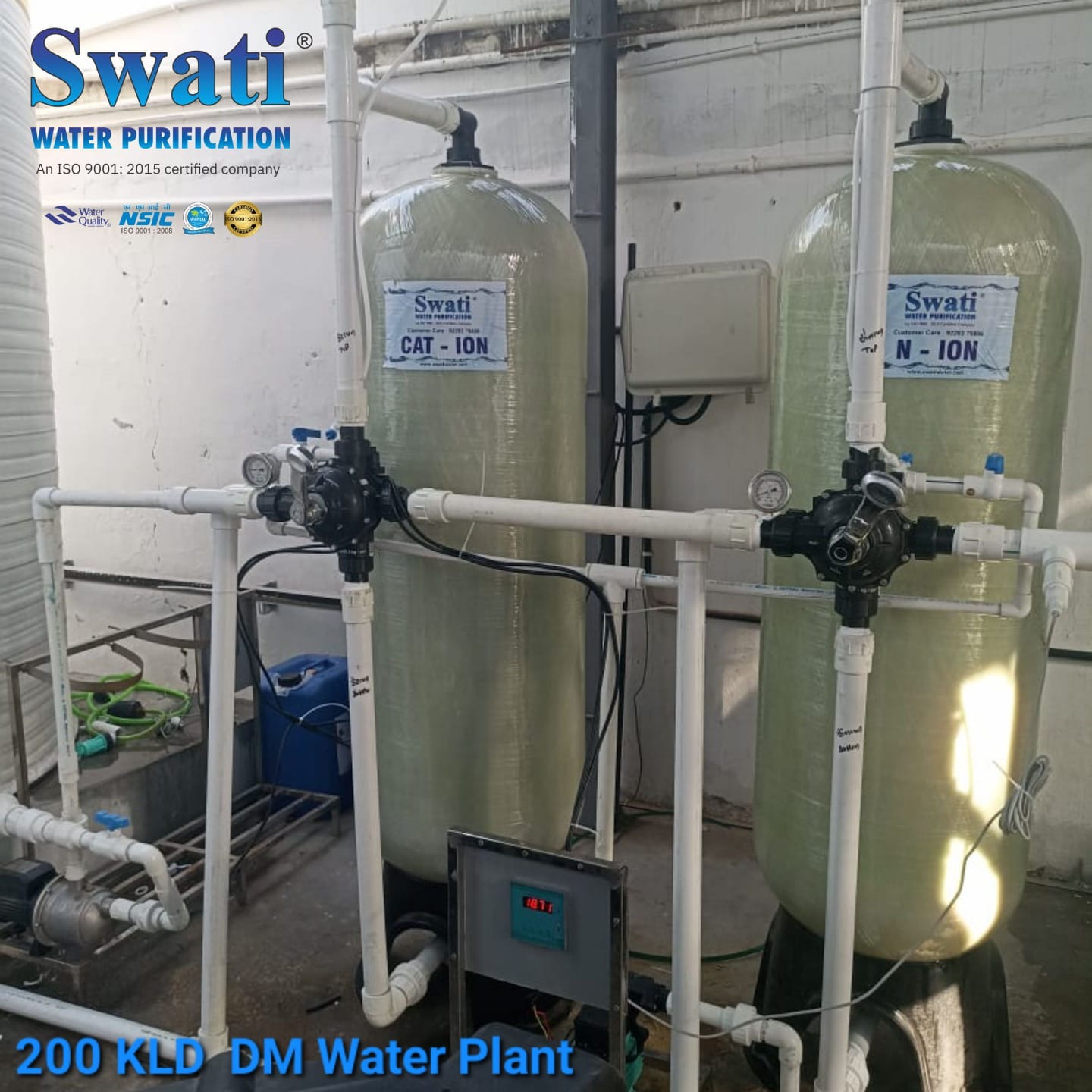
Premier DM Water Plant Manufacturer in Gujarat | Swati Water Purification
In Gujarat’s rapidly expanding industrial landscape, access to ultra-pure process water is essential for manufacturing integrity, thermal efficiency, and regulatory compliance. Dissolved mineral salts, calcium scale, chlorides, and metallic ions present in raw water cause scaling in high-pressure boilers, ruin delicate chemical formulations, and compromise pharmaceutical sterility.
Swati Water Purification is a recognized DM Water Plant Manufacturer in Gujarat. We engineer, manufacture, deliver, and commission high-capacity Demineralisation (DM) plants designed to strip ionic impurities from feedwater, delivering water with near-zero conductivity for complex industrial systems.
What is a DM Water Plant?
A DM Water Plant (Demineralisation Water Plant) is an advanced water treatment facility that uses chemical Ion Exchange technology to remove dissolved mineral salts and inorganic ions from raw water.While standard media filtration removes physical suspended solids and Reverse Osmosis (RO) removes bulk Total Dissolved Solids (TDS), a DM plant targets ionic species directly. By exchanging positively charged cations and negatively charged anions for hydrogen (H+) and hydroxyl (OH-) ions, a DM plant produces high-resistivity, mineral-free water suitable for critical utility and process applications.
Primary Industrial Applications of DM Water
Demineralized water is critical across diverse manufacturing and utility sectors:
Power & Thermal Energy: High-pressure boiler feedwater, steam turbine condensate polishing, and cooling tower makeup.
Pharmaceuticals & Healthcare: Process formulation base, equipment washing, laboratory reagents, and pure steam generation.
Chemical & Petrochemical Processing: Reaction solvent media, catalyst washing, and process heating loops.
Textiles & Fabric Processing: High-grade fabric washing and dye bath preparation where mineral salts disrupt shade accuracy.
Automotive & Electroplating: Surface pre-treatment, electro-deposition coating, and precision rinsing baths.
Electronics & Semiconductors: Microchip circuit rinsing and silicon wafer manufacturing requiring ultra-pure water.
Nationwide Supply Capabilities: Commercial & Industrial Reverse Osmosis (RO) Plants
In addition to our expertise as a leading DM Water Plant Manufacturer in Gujarat, Swati Water Purification specializes in designing, manufacturing, supplying, and installing high-capacity Commercial and Industrial Reverse Osmosis (RO) Plants across India.
We design, deliver, and install custom industrial RO skids tailored to local raw water conditions across key cities:
Gujarat: Ahmedabad, Gandhinagar, Surat, Vadodara, Rajkot, Bhavnagar, Jamnagar, Vapi.
Maharashtra: Mumbai, Pune, Nashik, Nagpur, Thane, Chakan, Aurangabad.
Madhya Pradesh: Bhopal, Indore, Gwalior, Jabalpur.
Rajasthan: Jaipur, Udaipur, Jodhpur, Bhiwadi, Kota.
Uttar Pradesh: Kanpur, Lucknow, Noida, Agra, Varanasi.
Our commercial and industrial RO systems range from 150 LPH to 50,000+ LPH, utilizing Thin-Film Composite (TFC) high-rejection membranes, multi-stage pre-filtration, automated flush cycles, and energy-efficient high-pressure pumps.
Frequently Asked Questions (FAQs)
Q1: What makes Swati Water Purification a top DM Water Plant Manufacturer in Gujarat?
We deliver custom-engineered DM plants built with corrosion-resistant vessels, high-capacity ion exchange resins, and automated controls. We back every installation with complete site commissioning and operator training.
Q2: What is the main difference between an RO Plant and a DM Plant?
An RO plant uses semi-permeable membranes under high pressure to filter out 90%–98% of total dissolved solids physically. A DM plant uses ion-exchange resin chemistry to extract specific dissolved ions, achieving near-zero mineral content and ultra-low electrical conductivity.
Q3: How do DM plant resins get regenerated?
When resin beds become saturated with trapped mineral ions, they undergo chemical regeneration. Hydrochloric Acid (HCl) restores the Cation resin bed, while Sodium Hydroxide (NaOH) regenerates the Anion resin bed.
Q4: What is a Mixed Bed DM Plant?
A Mixed Bed DM Plant combines Strong Acid Cation and Strong Base Anion resins within a single vessel. It serves as a polishing stage after a two-bed DM plant or RO system, producing ultra-pure water with electrical conductivity below 0.1uS/cm.
Q5: Is demineralized water safe to drink?
No. Demineralized water lacks essential natural minerals like calcium and magnesium needed for human health. Drinking DM water is unsafe because its flat taste and mineral-hungry nature can leach minerals from human body tissues over time.
Q6: How do I select the right DM plant capacity for my factory?
System capacity is determined by evaluating three factors:
Total daily required DM water volume in Liters per Hour (LPH) or Liters per Day.
Raw water total dissolved solids (TDS) and complete ionic breakdown (ppm).
Desired resin regeneration frequency (e.g., once every 24 hours or every 48 hours).
Q7: Does Swati Water Purification offer installation and maintenance services outside Gujarat?
Yes. We supply, install, commission, and service commercial RO plants and water treatment systems across major metropolitan hubs in India, including Mumbai, Pune, Nashik, Bhopal, Indore, Jaipur, and Kanpur.
Contact our water treatment engineering team today for a comprehensive technical evaluation and custom project quote!
Contact Us: +91 98251 83643 | +91 70439 99563
E-Mail : info@swatiwater.com | sales@swatiwater.com