
Comprehensive Guide to Reverse Osmosis Plants in Gujarat: Industrial Water Engineering with Swati Water Purification
Clean water availability dictates the operational momentum of modern commercial establishments and manufacturing floors. As groundwater tables shift and total dissolved solids (TDS) soar, untreated water threatens machinery longevity, product consistency, and regulatory compliance. For forward-thinking enterprises, deploying an advanced water treatment architecture is a paramount operational prerequisite.
At Swati Water Purification, we engineer, supply, and commission high-capacity Reverse Osmosis Plants in Gujarat and extended industrial zones across India. Whether your facility operates within a sprawling textile park, an automated bottling line, or a pharmaceutical formulation suite, our custom-engineered systems deliver unwavering purity.
The Mechanics of Industrial Reverse Osmosis
Reverse Osmosis leverages hydrodynamic pressure to overcome natural osmotic forces, driving fluid molecules through a semi-permeable synthetic barrier while rejecting dissolved ions, organics, and colloidal matter.
Core Processing Stages
Media Filtration: Multi-grade pressure sand filters extract suspended solids, while activated carbon beds strip free chlorine, volatile organics, and unpleasant tastes.
Chemical Conditioning: Precision dosing pumps introduce anti-scalants to inhibit calcium and magnesium precipitation on membrane surfaces.
High-Pressure Energetics: Multi-stage vertical centrifugal pumps elevate feed pressure to match osmotic resistance.
Separation Matrix: Spiral-wound polyamide membranes fractionate the stream into low-TDS permeate and mineral-concentrated reject water.
Polishing & Sterilization: Permeate passes through UV sterilizers or pH adjustment units before routing to service lines.
The Swati Water Purification Advantage
Navigating industrial water requirements demands deep technical insight and robust execution. Swati Water Purification differentiates itself through precision manufacturing and lifecycle accountability.
Custom Metallurgy & Sizing: We evaluate raw water chemistry parameters (pH, SDI, hardness, silica) to tailor frame-mounted FRP or SS skid systems that match exact spatial and volumetric thresholds.
Maximized Recovery Ratios: Our proprietary hydraulic designs push recovery metrics higher, curbing liquid discharge volumes and slashing utility expenditures.
Geographic Reach: Beyond our core stronghold in Gujarat, we maintain active supply and installation networks across Ahmedabad, Gandhinagar, Surat, Vadodara, Mumbai, Pune, Nashik, Bhopal, Indore, Jaipur, Kanpur, and neighboring industrial clusters.
Comprehensive Reverse Osmosis Plants Capacity Options
To accommodate global engineering standards and local plant requirements, our robust systems are available across three standard measurement metrics: Liters Per Hour (LPH), Cubic Meters Per Hour (M3/Hr), and Kilo Liters Per Hour (KLPH).
1. Capacity Range in Liter Per Hour (LPH)
Whether you need a compact system for a small facility or a heavy-duty setup for massive municipal output, our LPH range covers:
250 LPH | 500 LPH | 1000 LPH | 1500 LPH | 2000 LPH | 2500 LPH | 3000 LPH | 4000 LPH | 5000 LPH | 6000 LPH | 8000 LPH | 10000 LPH | 12000 LPH | 15000 LPH | 20000 LPH | 25000 LPH | 30000 LPH | 50000 LPH | 60000 LPH (and custom higher capacities upon request).
2. Capacity Range in Meter Cube Per Hour (M3/Hr)
For engineering specifications calculated in metric flow rates, choose from our reliable range:
1 M3/Hr | 1.5 M3/Hr | 2 M3/Hr | 2.5 M3/Hr | 3 M3/Hr | 4 M3/Hr | 5 M3/Hr | 6 M3/Hr | 8 M3/Hr | 10 M3/Hr | 12 M3/Hr | 15 M3/Hr | 20 M3/Hr | 25 M3/Hr | 30 M3/Hr | 50 M3/Hr | 60 M3/Hr
3. Capacity Range in Kilo Liter Per Hour (KLPH)
Seamlessly align with large-scale industrial project reports using our precise KLPH capacity tiers:
0.25 KLPH | 0.5 KLPH | 1 KLPH | 2 KLPH | 2.5 KLPH | 3 KLPH | 4 KLPH | 5 KLPH | 6 KLPH | 8 KLPH | 10 KLPH | 12 KLPH | 15 KLPH | 20 KLPH | 25 KLPH | 30 KLPH | 50 KLPH | 60 KLPH
Sector-Specific Utility Matrix
Different operational verticals require specific water purity thresholds. Our installations service diverse industrial segments:
Life Sciences & Healthcare: Delivering pyrogen-free water compliant with USP/IP standards for medical device rinsing and laboratory synthesis.
F&B Manufacturing: Guaranteeing uniform taste profiles, sanitation integrity, and strict microbiological compliance across beverage and dairy lines.
Textile Processing Hubs: Softening water parameters in Surat and Ahmedabad to eliminate dye precipitation and fabric degradation.
Thermal Power & Steam Utilities: Supplying ultra-low conductivity makeup water to prevent boiler tube scaling, foaming, and catastrophic heat-exchanger failure.
Commercial Real Estate: Fulfilling massive daily potable and utility demands for hotels, corporate campuses, and hospital complexes.
Technical & Economic Benefits
Integrating a professional-grade RO system yields immediate dividends across your balance sheet:
Process Reliability: Eliminates seasonal water quality fluctuations, ensuring continuous production batches without unexpected shutdowns.
Asset Preservation: Protects downstream heat transfer units, valves, and pipelines from corrosive mineral buildup.
Operational Savings: Eliminates recurring logistical costs tied to commercial water tanker dependencies.
Environmental Stewardship: Facilitates compliance with regional Pollution Control Board discharge norms through integrated wastewater recovery loops.
Frequently Asked Questions
1. How is the correct plant capacity determined?
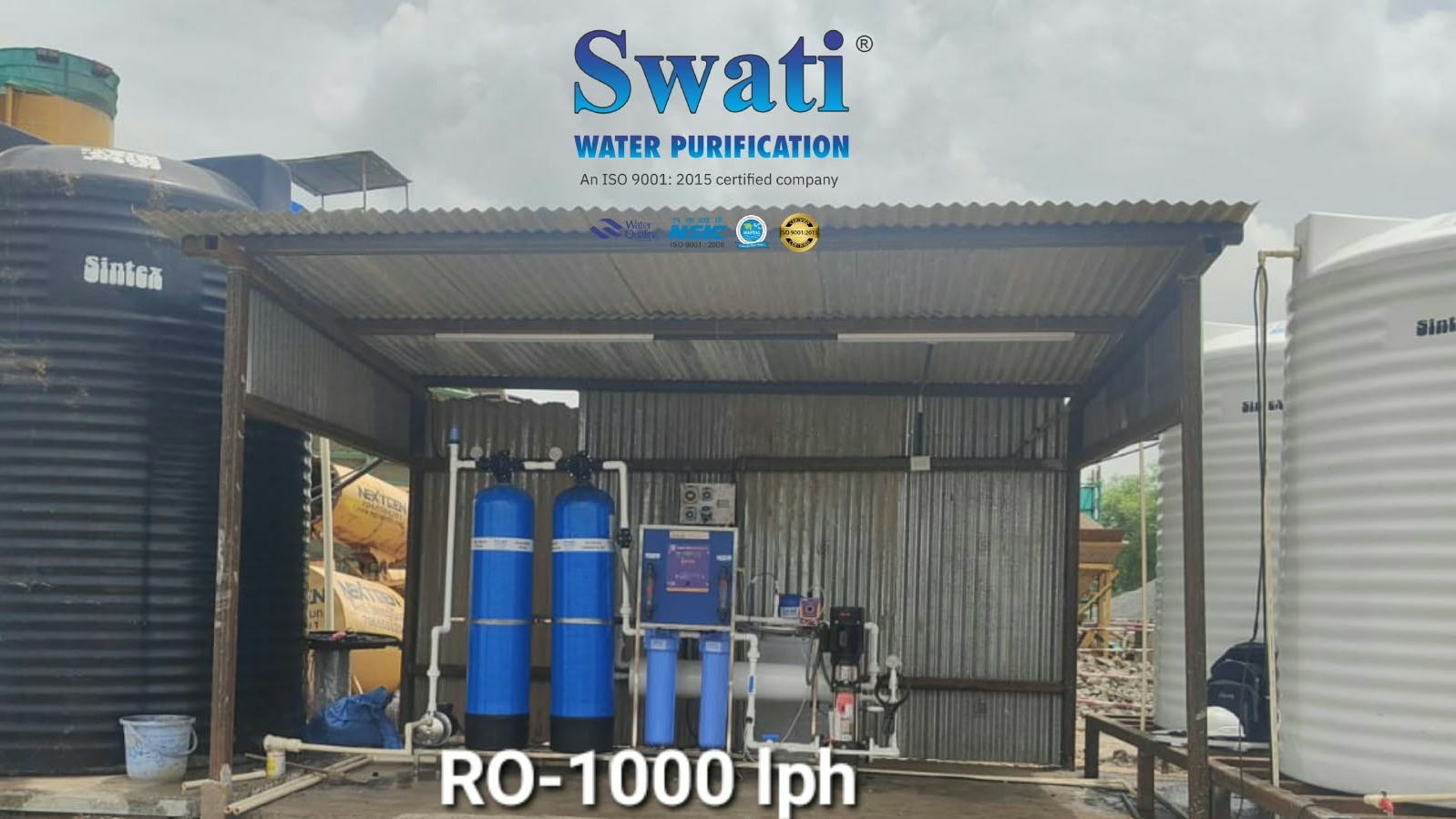
Capacity is calculated based on peak hourly demand, operating shift durations, and raw water recovery efficiency. Our engineering team conducts comprehensive site surveys to size units ranging from compact 1,000 LPH setups to multi-kiloliter industrial complexes.
2. What routine maintenance is mandatory for these systems?
Routine protocols include backwashing pre-treatment filters, monitoring differential pressures across membrane housings, scheduling Clean-In-Place (CIP) chemical washes, and replacing cartridge filters periodically.
3. What is the typical lifecycle of industrial RO membranes?
Under optimal pre-treatment regimes and correct chemical dosing, industrial-grade membranes generally function efficiently for 3 to 5 years.
4. Can the rejected brine stream be reclaimed?
Yes. Reject streams can be channelized through secondary recovery modules, or diverted for secondary utility tasks such as gardening, floor washdown, or ash handling.
5. Do you handle turnkey projects outside Gujarat?
Absolutely. Our field engineering teams execute end-to-end logistics, mechanical assembly, electrical integration, and operator training across key metropolitan zones like Mumbai, Pune, Indore, and Kanpur.
Secure Your Water Infrastructure Today
Optimize your enterprise performance with robust fluid management systems engineered for reliability. Partner with Swati Water Purification to future-proof your operations.
Reach out today to schedule a feed water analysis and consultation with our engineering specialists!
Contact Us: +91 98251 83643 | +91 70439 99563
E-Mail : info@swatiwater.com | sales@swatiwater.com