
Complete Water Softening System Guide: The Premier Water Softening System Manufacturer in Gujarat – Swati Water Purification
Hard water poses severe technical challenges to industrial equipment, commercial boilers, and plumbing infrastructure across Gujarat and urban centers in India. High concentrations of dissolved magnesium (Mg2+) and calcium (Ca2+) cations lead to rapid scale formation, reduced heat transfer efficiency, premature boiler tube failure, soaring electrical power consumption, and frequent operational downtime. As a leading Water Softening System Manufacturer in Gujarat, Swati Water Purification engineers, fabricates, installs, and services commercial water softeners, industrial ion-exchange systems, and Reverse Osmosis (RO) plants designed to handle challenging raw water chemistries.
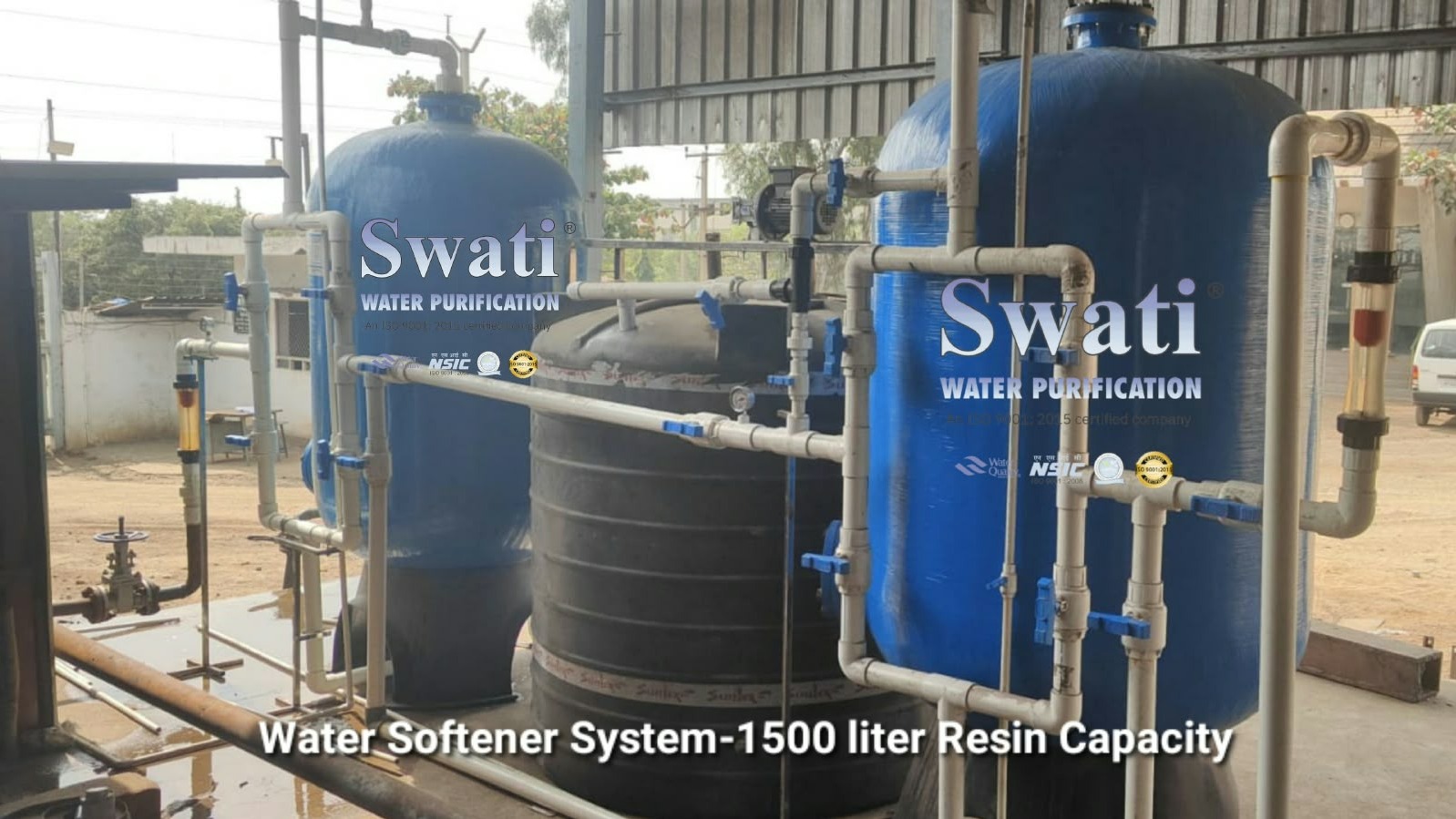
Understanding Water Softening and Reverse Osmosis Technology To choose the right water purification approach, it helps to understand how ion-exchange softeners and membrane filtration systems operate. Hard water problems occur when dissolved divalent calcium and magnesium ions combine with carbonates under heat or ambient evaporation. This creates insoluble calcium carbonate (CaCO3) and magnesium hydroxide (Mg(OH)2) scale that clogs pipelines and coats heat exchangers. An industrial water softening system solves this using Strong Acid Cation (SAC) resin beads saturated with sodium ions (Na+). As raw water passes through the resin bed, the calcium and magnesium cations are captured by the resin matrix, releasing harmless sodium ions into the treated water stream. Once the resin bed reaches maximum capacity, it is restored through a backwash cycle using a concentrated sodium chloride (NaCl) brine solution. A Reverse Osmosis (RO) system uses high-pressure pumps to force raw water across a semi-permeable membrane. While a water softener targets hardness ions specifically without significantly changing total dissolved solids (TDS), an RO system strips away up to 98% to 99% of all dissolved salts, heavy metals, silica, and microscopic contaminants.
Regional Footprint and Metropolitan Coverage
Swati Water Purification manufactures, installs, and services custom commercial water treatment units and heavy-duty Reverse Osmosis plants across key industrial hubs:
Primary Coverage in Gujarat
Ahmedabad & Gandhinagar: High-capacity installations for pharmaceutical units, textile mills, commercial complexes, and IT parks.
Surat & Bharuch: Specialized softeners for textile dyeing, chemical processing, and synthetic fabric plants.
Vadodara & Ankleshwar: Heavy-duty systems built for chemical plants, refineries, power plants, and manufacturing facilities.
Rajkot, Bhavnagar, Jamnagar & Vapi: Comprehensive industrial water conditioning and pretreatment units.
Metropolitan Expansion Across India
Maharashtra: Mumbai, Pune, Nashik, Nagpur, Thane, Chakan, and Aurangabad.
Madhya Pradesh: Bhopal, Indore, Gwalior, and Ujjain.
Northern & Central Industrial Belts: Kanpur, Lucknow, Noida, Ghaziabad, Jaipur, Udaipur, and Bhiwadi.
Core Applications Across Key Industries
Softened, scale-free water plays a crucial role in maintaining productivity across multiple commercial and industrial sectors:
Boiler Feedwater and Steam Systems
Dissolved hardness forming scale inside high-pressure steam boilers acts as an insulating layer against heat transfer. A layer of scale just 1 millimeter thick can increase fuel consumption by up to 10% and create localized hotspots that lead to boiler tube bursts. Softened water eliminates internal encrustation.
Cooling Towers and Heat Exchangers
Cooling water continuously evaporates, concentrating mineral salts inside heat exchanger pipes and tower fills. Installing a softener reduces the need for constant blowdown cycles, protects heat transfer equipment, and minimizes biological and mineral scale accumulation.
Textile and Dyeing Facilities
The textile industry relies on zero-hardness water to achieve precise dye absorption, uniform fabric bleaching, and bright color shades. Soft water prevents chemical precipitation in dye baths, cutting down on extra chemical additives and rework costs.
Pharmaceutical and Biotech Production
Water softeners serve as critical pretreatment units upstream of Reverse Osmosis (RO). Removing divalent cations prevents premature scaling on sensitive RO membrane surfaces.
Commercial Laundries and Hospitality
In hotels and commercial laundries, hard water reacts with soaps to form insoluble curds, leading to stiff, discolored linens and rapid fabric wear. Soft water cuts detergent usage by 40% to 50%, protects commercial washing machines, and extends linen life.
Key Operational Benefits
Investing in a custom water softener from Swati Water Purification offers key operational and financial advantages:
Substantial Energy Savings: Scale-free heating elements, cooling coils, and heat exchangers maintain optimum heat exchange rates, reducing fuel and electricity usage.
Longer Machinery Life: Eliminates abrasive mineral encrustation inside pumps, control valves, chillers, dishwashers, and piping networks.
Reduced Chemical Expenses: Drastically reduces soap, detergent, boiler antiscalant, and acid-wash chemical consumption.
Protecting RO Membranes: Pre-softening raw feedwater prevents calcium sulfate and calcium carbonate scale buildup on RO membrane sheets, extending membrane service life.
Flexible Control Configurations: Available in manual, semi-automatic, or fully automatic multiport valve (MPV) options, as well as PLC-controlled automatic valve skids.
Frequently Asked Questions (FAQs)
Q:1 Why select Swati Water Purification as your water softener manufacturer in Gujarat?
A:Swati Water Purification builds long-lasting, high-capacity water softening units engineered with top-grade resin media, durable pressure vessels, and dependable multiport control valves. We deliver full engineering design, installation, commissioning, and after-sales support for clients in Gujarat and across India.
Q:2 What is the difference between a Water Softener and a Reverse Osmosis (RO) System?
A: A water softener selectively exchanges hardness ions (calcium and magnesium) for sodium ions using ion-exchange resin without significantly lowering overall water TDS. An RO plant uses semi-permeable membranes under pressure to filter out up to 99% of total dissolved solids, heavy metals, salts, and microscopic pollutants.
Q:3 How do engineers calculate the right softener capacity for a facility?
A: System sizing depends on three core values: peak hourly water demand (in liters per hour), incoming total raw water hardness (in ppm or mg/L as CaCO3), and the desired regeneration interval (such as once every 24 hours or after a specific shift). Our technical team uses these values to calculate the required resin volume and vessel dimensions.
Q:4 How often does an industrial water softener require brine regeneration?
A: Regeneration frequency depends on raw water hardness and daily volume usage. Automated flow-metered systems track total water output and trigger brine draw cycles automatically once the resin bed reaches its exchange capacity limit.
Q:5 What maintenance does an industrial water softening plant require?
A: Routine maintenance involves keeping the brine tank stocked with clean industrial sodium chloride (NaCl), monitoring inlet and outlet pressure differentials, periodically backwashing the resin bed to clear trapped particulate matter, and checking resin capacity annually.
Contact Us: +91 98251 83643 | +91 70439 99563
E-Mail : info@swatiwater.com | sales@swatiwater.com