
Ahmedabad
08048047559
+919825183643
Industrial Reverse Osmosis Plant, RO Plants by Swati Water Purification

Industrial RO System

Phone Number

08048047559

Please keep 0 before dialling the number.

Mon-Thu: 10 AM - 2 PM • Fri: 3 PM - 7AM

Address 526/1, Bhagyalaxmi Industrial Estate, Bhadaj to Rakanpur Road, Near Ahmedabad, Ta-Kalol, Dist-Gandhinagar-382721

Ahmedabad, India, 382721
Description

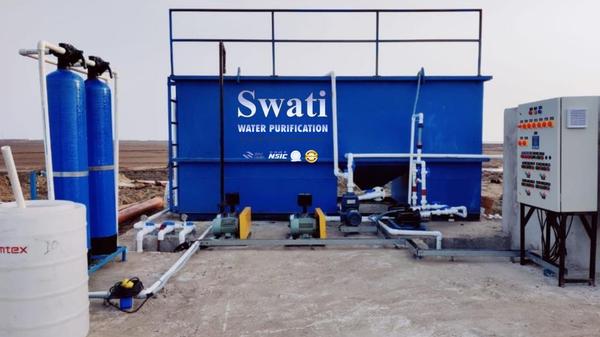
An Industrial Reverse Osmosis (RO) system for the paint industry is primarily designed to produce demineralized water (DM water), which is essential for manufacturing high-quality, water-based paints, coatings, and pigments. The stringent water quality requirements of the paint industry necessitate a multi-stage system to prevent final product defects like flocculation, color inconsistencies, and instability. Key Application and Purpose The main goal is to supply water with ultra-low Total Dissolved Solids (TDS) and hardness to the manufacturing process. · Manufacturing Water-Based Products: RO water prevents the reaction of minerals (especially calcium, magnesium, and iron) with sensitive organic/inorganic pigments and thickening agents, which can lead to coagulation, poor viscosity, and color defects. · Pigment and Resin Dilution: High-purity water is critical for achieving the precise chemical balance required during the dilution and dispersion of pigments and resins. · Equipment Cleaning: RO water is often used for the final rinse of mixing tanks and equipment to avoid leaving mineral residue that could contaminate the next batch. Application and Typical Capacities The primary application of an RO system in the paint industry is to produce demineralized water for use in manufacturing water-based paints, coatings, and pigments. High-purity water (very low in TDS, hardness, and iron) is essential to prevent defects like flocculation, inconsistencies in viscosity, and color shifts in the final product. It is also used to treat and reuse wastewater from washing and cleaning processes. Capacities: RO plant capacity is scaled to meet the manufacturer's daily water demand: Small/Medium Plants: 500 to 5,000 Liters Per Hour (LPH). Large Plants: 10,000 to 60,000+ LPH.

Other Products

view all

6814772a5d263414004dd4a4 Card 2

product image
Commercial Sewage Treatment Plant

A commercial sewage treatment plant is a facility designed to treat wastewater (sewage) from commercial, industrial, or residential sources before it is released into the environment or reused. Unlike municipal plants that handle city-wide sewage, commercial plants are often smaller, modular, and tailored to the needs of businesses, hotels, restaurants, factories, or small communities. We Are Manufacturers & Suppliers In Ahmedabad, Gandhinagar, Gujarat, India, Sanand GIDC, Mehsana, Vitthalapur, Mandal Bechraji Special Investment Region(MBSIR), Halol GIDC, Bavla Kerala GIDC, Dahej SIR & PCPIR(Petroleum, Chemicals and Petrochemicals Investment Region), Dholera SIR, GIDC Industrial Area(Gujarat Industrial Development Corporation), MIDC Industrial Area(Maharashtra Industrial Development Corporation), MPIDC Industrial Area(Madhya Pradesh Industrial Development Corporation), RIICO Industrial Area(Rajasthan State Industrial Development & Investment Corporation), PSIDC(Punjab State Industrial Development Corporation), SEZs Area(Special Economic Zones), SEEZ Area(Solar Energy Enterprises Zone) In Rajasthan, Peenya Industrial Area In Bengaluru(Bengalore, Karnataka) etc.. Capacities: • 10 KLD/ 15 KLD/ 20 KLD/ 25 KLD/ 30 KLD/ 40 KLD/ 50 KLD/ 65 KLD/ 75 KLD/ 80 KLD/ 100 KLD/ 150 KLD/ 175 KLD/ 200 KLD/ 250 KLD/ 300 KLD/ 350 KLD/ 400 KLD/ 450 KLD Purpose Remove pollutants: Organic matter, suspended solids, pathogens, oils, and chemicals. Protect the environment: Prevent contamination of rivers, lakes, and groundwater. Comply with regulations: Meet local and national wastewater discharge standards. Reuse water: Treated water can sometimes be reused for irrigation, cleaning, or cooling. Advantages Reduces environmental pollution. Allows water recycling. Customizable to flow rate and type of wastewater.

6814772a5d263414004dd4a4 Card 2

product image
Domestic Sewage Treatment Plant

A Domestic Sewage Treatment Plant is a wastewater treatment system specifically designed to treat sewage generated from households and residential complexes. It ensures that the wastewater is safely treated for discharge or reuse, complying with environmental standards. Capacities: The Amount Of Wastewater It Can Treat Per Day(5 KLD to 500 KLD)(1 MLD-50 MLD) Advantages - Safe treatment of domestic wastewater - Compliance with local pollution control norms - Compact and modular design - Reuse of treated water reduces freshwater consumption - Scalable based on population or household load Applications Individual houses & villas Apartment complexes & housing societies Resorts & hotels Schools & colleges Small industries or office complexes

6814772a5d263414004dd4a4 Card 2

product image
Modular Sewage Treatment Plant

A Modular Sewage Treatment Plant is a compact, pre-fabricated, and scalable wastewater treatment solution that ensures efficient sewage treatment, easy installation, and future expandability for residential, commercial, or industrial applications. Advantages - Modular & compact design - Quick deployment - Energy-efficient operation - Easy expansion for future needs - Compliance with pollution control regulations - Reduced civil work A Modular Sewage Treatment Plant (STP) comes in various capacities depending on the application, population served, and wastewater flow. Modular STPs are scalable because multiple units can be combined to achieve higher capacities. 1. Small-Capacity Modular STP Capacity: 1 KLD – 50 KLD (1,000 – 50,000 liters/day) Applications: Individual villas or small residential complexes Small offices or clinics Remote construction or labor camps 2. Medium-Capacity Modular STP Capacity: 50 KLD – 500 KLD Applications: Housing societies / apartment complexes Hotels and resorts Schools and small industries Commercial buildings 3. Large-Capacity Modular STP Capacity: 500 KLD – 5000 KLD (0.5 – 5 MLD) Applications: Large residential townships Industrial complexes Airports, railway stations, or metro stations Large commercial or government projects